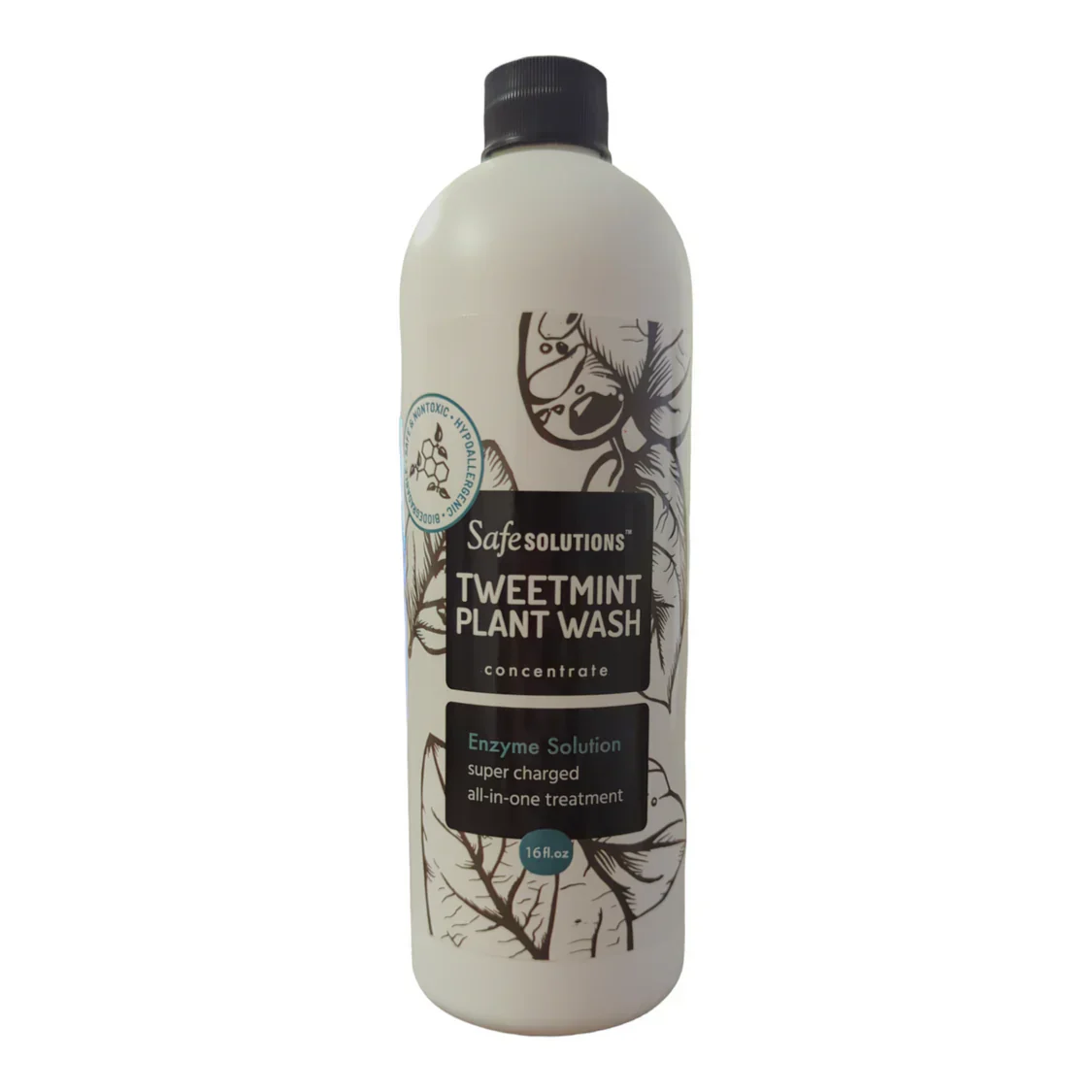

Tweetmint Enzyme Plant Wash
Safe Solutions Enzyme Plant Wash controls pests such as insects, bacteria, mildew and mold. The enzymes used in the formula exhibit the same properties as those that occur naturally in all insect species - causing a digestive disintegration of the exoskeleton. When enzyme makes contact with an insect, it quickly digests its exoskeleton resulting in prompt death. This process does not harm human skin and is 100% safe, non-toxic and hypoallergenic.
The ingredients of Enzyme Plant Wash are recognized as Non-Toxic, Food Grade, or GRAS (Generally Recognized As Safe) and are pH balanced, hypoallergenic & biodegradable.
Enzyme Plant Wash is a valuable alternative to using pesticide in situations where there are chemically-sensitive people such as those who are pregnant, infants, elderly, ill or MCS.
Typically, a dilution of 2 to 4 oz. Enzyme Plant Wash concentrate per gallon of water will kill most any insect in several seconds. Arachnids such as spiders and ticks have stronger exoskeletons than arthropods and may take several minutes to succumb to the enzyme. When spraying outdoors a dilution of ½to 1 oz. Enzyme Plant Wash per gallon of water is a better solution so that collateral damage to beneficial insects is prevented. This solution works well for organic gardening / farming or as a drench for ant or yellow jacket nests.
The dilution rate of the enzyme concentrate can be calibrated to affect only specific target species but weak enough to protect beneficial insects such as honey bees. For example, a dilution of 1 oz. Enzyme Plant Wash per 5 gallons of water can be used in organic gardening to remove softer-bodied aphids, but will not harm beneficial insects such as honey bees. Start with a weak dilution and increase concentration until the target insect is pinpointed.
Indoors, Enzyme Plant Wash is fantastic for washing floors and furniture, laundry and linens, tub and tile to remove them not only of stubborn stains but also prevent insect invaders.
Outdoors, Enzyme Plant Wash is great for organic gardening, landscaping, and lawn care. It is non-toxic and biodegradable, so it can be fogged or sprayed onto vegetables, fruit trees, orchards, crops and lake or pond water restoration without fear of contamination.
Caution: Safe Solutions Enzyme Plant Wash is a broad-range bio-pesticide and will kill all insects including beneficials, so use them outdoors with great discretion!
* Safe Solutions is currently seeking to register their Enzyme Plant Wash with the EPA as a bio-insecticide. Official pesticidal claims cannot be made until it is registered with EPA.
Because commercial pesticides are comprised of chemicals which are volatile, synthetic and poisonous, the EPA prohibits registered pesticides from claiming they are either safe or non-toxic. However, since Safe Solutions Enzyme Plant Wash is in fact a natural biological pesticide that affects insects based on physical rather than chemical properties, it is better to refer to it as a Pestisafe® rather than as a pesticide.
Be aware that not all enzyme cleaners are safe to use for non-toxic pest control, most are not designed for this purpose and many are toxic such as those purchased at swimming pool supplies or janitorial supplies, e.g. drain openers and septic tank treatment cleaners. Other biological detergents available on the market are not manufactured for pest control. Only Safe Solutions Enzyme Plant Wash is patented for the purpose of non-toxic pest control.
Pesticides present risks to human health. Although the rate of post-application degradation may vary widely, almost all pesticides present some direct risk to human health through residual toxicity, i.e. direct human contact with pesticide residues remaining after treatment, whether through inhalation of volatile toxic vapors, skin contact and transdermal absorption, or ingestion. In addition, many pesticides present indirect risks to human health in the form of environmental pollution, most notably pollution with persistent, halide-substituted organics which accumulate in the fat stores of food fish and other animals. These problems have led to complete bans on the use of some pesticides (e.g., DDT, chlordane, heptachlor, aldrin, and dieldrin); while the continued use of the remaining pesticides has produced a new problem: the increasing development of widespread resistance to pesticides in insects.
This resistance yields two results: 1) quick reinfestation by the pest insect; 2) the need and cost of continually engineering new pesticides (e.g., synthetic pyrethroids were developed because of resistance to the less toxic first generation pyrethrins). New pesticide production takes time and the new pesticides that result are almost universally more expensive than those they replace.
In this context, traditional pesticides are applied on a regular, and typically increasing, basis. For example, many schools have come to be sprayed monthly or even biweekly, and with increasing quantities of pesticides to combat endemic roach re-infestations, often to no avail. This intensifies the problem of residual toxicity to people, especially to children who, as a result, may suffer headaches, grogginess, nausea, dizziness, irritability, frenetic behavior, and an impaired readiness to learn.
Because of these effects, it has been recognized that totally new approaches must be discovered and implemented in order to effectively control invertebrate pests without destroying human health and the environment. There is a need for a quick-acting, effective, residually non-toxic method for combating insect, arachnid, and other pests which may be used as a replacement for traditional pesticide treatments and as a supplement to the arsenal of currently available IPM techniques.
Consequently, it is an object of the present invention to provide a method for combating invertebrate (i.e. insect and arachnid) and microbe (i.e. bacterial, algal, fungal, and/or viral) pests which is quick-acting, effective, and residually non-toxic and which may be used as a replacement for traditional pesticide treatments and as a supplement to the arsenal of currently available integrated pest management techniques.
It has been surprisingly found that the application of a composition comprising at least one protease enzyme is a method for exterminating pests which achieves these objectives. The enzyme component of the invention may comprise a single protease or a protease-containing mixture of enzymes, whether natural, preformed, or synthetic. In an alternate embodiment, the composition may also comprise a detergent component. This detergent component comprises one or more surfactant(s), detergent builder(s), or mixtures thereof.
(Safe Solutions, Inc. does not make pesticidal claims regarding its Enzyme Plant Wash)
Useful Info Cont.
How To Use
Original: $54.99
-70%$54.99
$16.50Product Information
Product Information
Shipping & Returns
Shipping & Returns
Description
Safe Solutions Enzyme Plant Wash controls pests such as insects, bacteria, mildew and mold. The enzymes used in the formula exhibit the same properties as those that occur naturally in all insect species - causing a digestive disintegration of the exoskeleton. When enzyme makes contact with an insect, it quickly digests its exoskeleton resulting in prompt death. This process does not harm human skin and is 100% safe, non-toxic and hypoallergenic.
The ingredients of Enzyme Plant Wash are recognized as Non-Toxic, Food Grade, or GRAS (Generally Recognized As Safe) and are pH balanced, hypoallergenic & biodegradable.
Enzyme Plant Wash is a valuable alternative to using pesticide in situations where there are chemically-sensitive people such as those who are pregnant, infants, elderly, ill or MCS.
Typically, a dilution of 2 to 4 oz. Enzyme Plant Wash concentrate per gallon of water will kill most any insect in several seconds. Arachnids such as spiders and ticks have stronger exoskeletons than arthropods and may take several minutes to succumb to the enzyme. When spraying outdoors a dilution of ½to 1 oz. Enzyme Plant Wash per gallon of water is a better solution so that collateral damage to beneficial insects is prevented. This solution works well for organic gardening / farming or as a drench for ant or yellow jacket nests.
The dilution rate of the enzyme concentrate can be calibrated to affect only specific target species but weak enough to protect beneficial insects such as honey bees. For example, a dilution of 1 oz. Enzyme Plant Wash per 5 gallons of water can be used in organic gardening to remove softer-bodied aphids, but will not harm beneficial insects such as honey bees. Start with a weak dilution and increase concentration until the target insect is pinpointed.
Indoors, Enzyme Plant Wash is fantastic for washing floors and furniture, laundry and linens, tub and tile to remove them not only of stubborn stains but also prevent insect invaders.
Outdoors, Enzyme Plant Wash is great for organic gardening, landscaping, and lawn care. It is non-toxic and biodegradable, so it can be fogged or sprayed onto vegetables, fruit trees, orchards, crops and lake or pond water restoration without fear of contamination.
Caution: Safe Solutions Enzyme Plant Wash is a broad-range bio-pesticide and will kill all insects including beneficials, so use them outdoors with great discretion!
* Safe Solutions is currently seeking to register their Enzyme Plant Wash with the EPA as a bio-insecticide. Official pesticidal claims cannot be made until it is registered with EPA.
Because commercial pesticides are comprised of chemicals which are volatile, synthetic and poisonous, the EPA prohibits registered pesticides from claiming they are either safe or non-toxic. However, since Safe Solutions Enzyme Plant Wash is in fact a natural biological pesticide that affects insects based on physical rather than chemical properties, it is better to refer to it as a Pestisafe® rather than as a pesticide.
Be aware that not all enzyme cleaners are safe to use for non-toxic pest control, most are not designed for this purpose and many are toxic such as those purchased at swimming pool supplies or janitorial supplies, e.g. drain openers and septic tank treatment cleaners. Other biological detergents available on the market are not manufactured for pest control. Only Safe Solutions Enzyme Plant Wash is patented for the purpose of non-toxic pest control.
Pesticides present risks to human health. Although the rate of post-application degradation may vary widely, almost all pesticides present some direct risk to human health through residual toxicity, i.e. direct human contact with pesticide residues remaining after treatment, whether through inhalation of volatile toxic vapors, skin contact and transdermal absorption, or ingestion. In addition, many pesticides present indirect risks to human health in the form of environmental pollution, most notably pollution with persistent, halide-substituted organics which accumulate in the fat stores of food fish and other animals. These problems have led to complete bans on the use of some pesticides (e.g., DDT, chlordane, heptachlor, aldrin, and dieldrin); while the continued use of the remaining pesticides has produced a new problem: the increasing development of widespread resistance to pesticides in insects.
This resistance yields two results: 1) quick reinfestation by the pest insect; 2) the need and cost of continually engineering new pesticides (e.g., synthetic pyrethroids were developed because of resistance to the less toxic first generation pyrethrins). New pesticide production takes time and the new pesticides that result are almost universally more expensive than those they replace.
In this context, traditional pesticides are applied on a regular, and typically increasing, basis. For example, many schools have come to be sprayed monthly or even biweekly, and with increasing quantities of pesticides to combat endemic roach re-infestations, often to no avail. This intensifies the problem of residual toxicity to people, especially to children who, as a result, may suffer headaches, grogginess, nausea, dizziness, irritability, frenetic behavior, and an impaired readiness to learn.
Because of these effects, it has been recognized that totally new approaches must be discovered and implemented in order to effectively control invertebrate pests without destroying human health and the environment. There is a need for a quick-acting, effective, residually non-toxic method for combating insect, arachnid, and other pests which may be used as a replacement for traditional pesticide treatments and as a supplement to the arsenal of currently available IPM techniques.
Consequently, it is an object of the present invention to provide a method for combating invertebrate (i.e. insect and arachnid) and microbe (i.e. bacterial, algal, fungal, and/or viral) pests which is quick-acting, effective, and residually non-toxic and which may be used as a replacement for traditional pesticide treatments and as a supplement to the arsenal of currently available integrated pest management techniques.
It has been surprisingly found that the application of a composition comprising at least one protease enzyme is a method for exterminating pests which achieves these objectives. The enzyme component of the invention may comprise a single protease or a protease-containing mixture of enzymes, whether natural, preformed, or synthetic. In an alternate embodiment, the composition may also comprise a detergent component. This detergent component comprises one or more surfactant(s), detergent builder(s), or mixtures thereof.
(Safe Solutions, Inc. does not make pesticidal claims regarding its Enzyme Plant Wash)